Soft SMD Contact Pads vs Spring Finger Contacts: How to Choose?
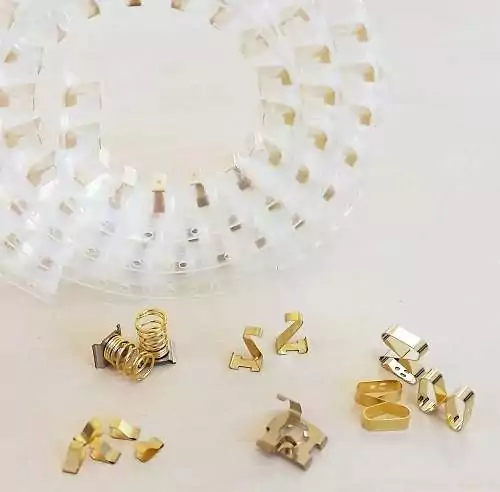
01 — What is the problem?
Both soft SMD contact pads and spring finger contacts serve the same fundamental purpose: establishing reliable electrical connections on printed circuit boards for grounding, EMI reduction, and static discharge. However, they rely on very different mechanical principles — compressible foam/silicone bodies vs. spring mechanisms — which makes each suited to different application environments. Choosing the wrong technology can lead to connection failures, excessive EMI, or unnecessary cost.
02 — Why does it happen?
- Soft SMD contact pads use a metallic strip on a foam or silicone body, offering up to 90% compression — ideal for confined spaces with minimal mechanical stress on the PCB.
- Spring finger contacts incorporate a spring mechanism that maintains constant pressure and stable conductivity, even under vibration, shock, or thermal cycling.
- Both are supplied in reels for automated SMT placement, but their mechanical behavior and environmental resistance differ significantly.
- The choice depends on the balance between compressibility needs, environmental harshness, EMI performance, and budget constraints.
03 — Consequences
- Using soft pads in high-vibration environments may result in intermittent ground connections and EMI leakage.
- Using spring contacts where high compressibility is needed may create excessive mechanical stress on the PCB or components.
- Over-specifying (spring contacts where soft pads suffice) increases component cost without added value.
- Under-specifying (soft pads in extreme conditions) risks connection failure, static buildup, and electromagnetic interference.
04 — Common mistakes
- ✗Selecting contact type based solely on cost without evaluating the mechanical and environmental requirements.
- ✗Ignoring compression range specifications — soft pads handle 50–90% compression, spring contacts typically 5–40%.
- ✗Overlooking vibration and shock requirements that favor spring contacts over soft pads.
- ✗Assuming both technologies offer identical EMI shielding performance in all conditions.
- ✗Not considering the long-term reliability under temperature cycling and humidity exposure.
05 — Possible solutions
- ✓Choose soft SMD contact pads when: you need high compressibility (up to 90%), space is limited, mechanical stress must be minimized, or cost is a primary concern. Silicone-based pads are especially effective for EMI noise reduction.
- ✓Choose spring finger contacts when: the application faces vibrations, shocks, humidity, or temperature variations. They provide superior reliability for antenna connections, PCB-to-chassis grounding, and low-voltage connections requiring stable conductivity.
- ✓For automotive applications: spring contacts for engine bay and safety-critical systems (vibration resistance); soft pads for dashboard electronics and infotainment (space efficiency).
- ✓For industrial equipment: evaluate operating temperature range and vibration levels — harsh conditions favor spring contacts, controlled environments favor soft pads.
- ✓For consumer electronics: soft pads often provide the best cost-performance balance in phones, cameras, and household appliances with limited mechanical stress.
- ✓When in doubt, prototype both solutions and measure contact resistance under realistic operating conditions before committing to production.
06 — Related topics
Need help on a specific case? Reach out directly: